
IN THE NEWS
From the Apollo to Padres Ownership
Media Coverage . August 25, 2026
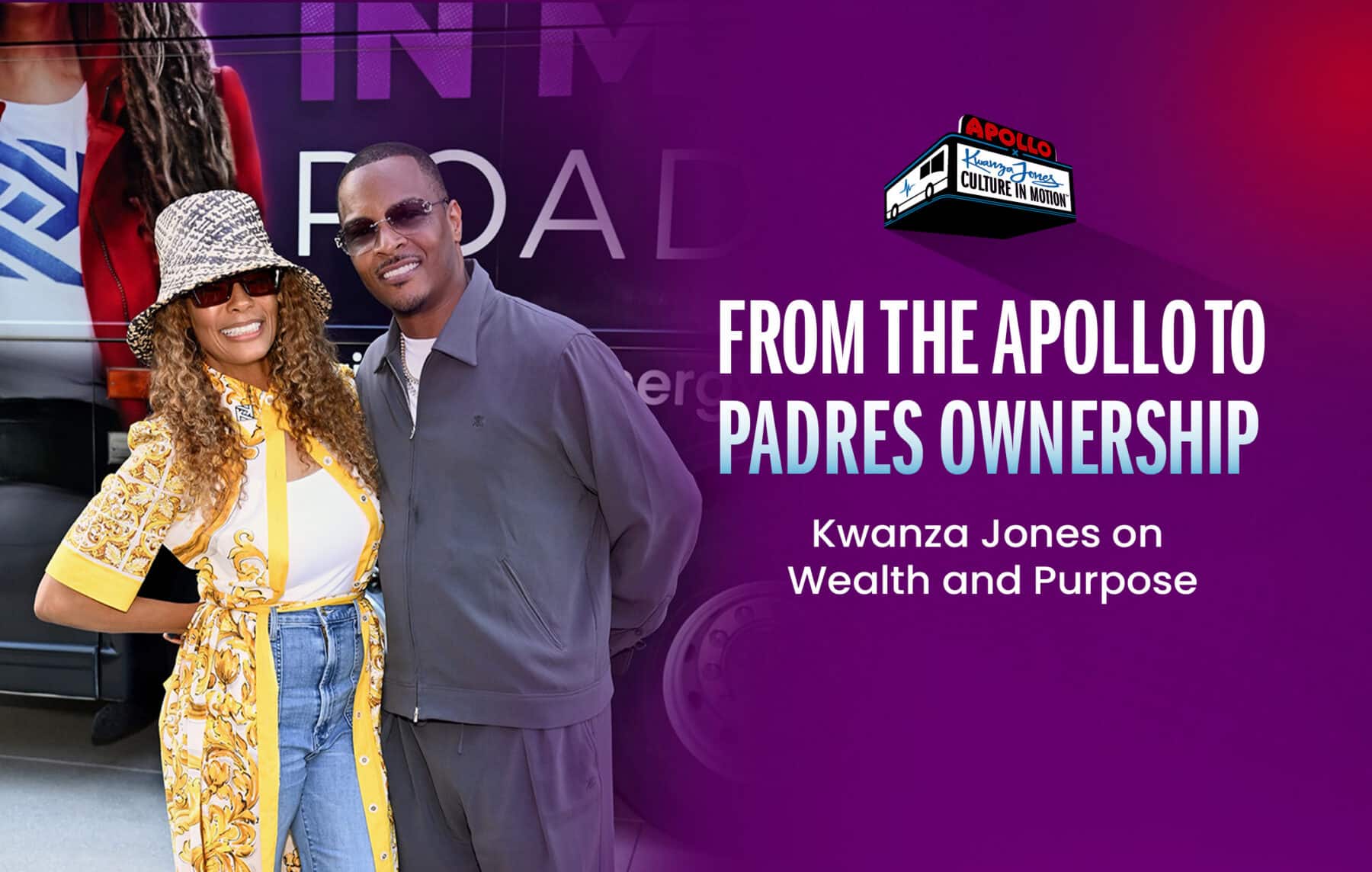
Transcript
Tip T.I. Harris (0:01)
Uhhuh. Now, the following experience is not a test. The conversations and stories expressed on this podcast are meant to be an expression of [music] purpose and truth. This show, properly entitled expeditiously, is a free exchange of ideas and opinions.
No judgment, no preconceived beliefs, no fear. [music] You’re encouraged to share your thoughts and ask any question as long as it’s done with respect. And it’s through true love and respect for others that we will change the world and speak truth to power one show at a time. Now, without further ado, this is Expeditiously. I’m Tip T.I. Harris.
Tip T.I. Harris (0:36)
I’m Tip T.I. Harris, and I’m your host of Expeditiously.
I guest today is an extraordinary one, and they’re proof that you don’t have to stay in one lane to build an extraordinary career. Now, she started in music, where she carved out a lane and a name for herself as a recording artist and performer, even taking the stage at the legendary venue Apollo, the Apollo Theater in Harlem.
That’s going to be a part of the story later, so remember that. Now, she quickly expanded her path, becoming an entrepreneur, investor, and philanthropist, with focus built on building businesses and supporting ideas that create real-world impact.
Today, she’s known for blending creativity with strategy and passion with purpose. And, if that weren’t enough, she’s also part of the ownership group of the San Diego Padres, which is a historical move. Her stepping into the world of professional sports and continuing to push boundaries in every direction she moves.
Her story is about evolution, reinvention, and never being afraid to think bigger than the box you’re put in. Please welcome to Expeditiously, Kwanza Jones. What’s happening?
Kwanza Jones (1:42)
Hey, hey, hey. How are you? How’s it going? I’m just going to make sure this mic is where it needs to be, doing what it needs to do. Because my father always said, “Make sure when you walk into a room, you can be heard.”
Tip T.I. Harris (1:51)
You know what I’m saying?
Kwanza Jones (1:51)
Here we go, that’s what happens.
Tip T.I. Harris (1:54)
Okay, well, well, well, Miss Jones, how did we get here?
Kwanza Jones (2:02)
Oh, well, way back in the day.
Tip T.I. Harris (2:06)
What was your dream as a young Kwanza? What was your dream?
Kwanza Jones (2:10)
Young Kwanza. You know, there’s something that I say always, and it’s that I am supercharged. Don’t doubt it, just believe it.
So, my dream has always been to step into always learning and growing and understanding the power that you have.
So, young Kwanza did a number of things. Met heads of state and presidents of so many different countries. I used to be on the Board of Education when I was a student in Washington, D.C.
Young Kwanza just did a lot of things. I ran track.
I performed at the Apollo.
Tip T.I. Harris (2:44)
Okay. As a kid?
Kwanza Jones
Not as a kid. Actually, by then it was—I’ll call that college Kwanza.
Tip T.I. Harris
Okay, got it.
Kwanza Jones
That was when I—by the time I got to Princeton, that’s it. But my dream was always just to impact.
Tip T.I. Harris (2:52)
You just breeze by Princeton.
Kwanza Jones (2:59)
Well, you know, because some people are caught up on degrees and names and what you have behind your name in terms of those letters.
For me, life is about learning, and you can learn from so many different things. And it doesn’t have to be—no shade to Princeton. I love Princeton. My husband went to Princeton. One of my sisters went to Princeton. So, I’ve got deep love.
There are dorms named after me at Princeton.
Tip T.I. Harris
Yes.
Kwanza Jones
First time in over 250 years that there are dorms named after—one after me, Kwanza Jones, and one after my husband, José Feliciano, at Princeton. Ever. First time ever.
Tip T.I. Harris (3:36)
Amazing. So, what was your earliest inspiration?
Kwanza Jones (3:40)
I will say—and I don’t even know if it was inspiration as much as it was training
Tip T.I. Harris (3:45)
Okay
Kwanza Jones (3:45)
which my parents, who are both lawyers, and my dad, rest in peace and power, always said: “You can’t live just for you.”
That was my inspiration: understanding that life is not about you. It’s about how and who you do life with. And that means you are part of a community. That means you have a responsibility to the community and communities that you are part of.
So, I’ll say—and I know a lot of folks oftentimes say it’s their families. It really was. It was family for me was an inspiration, and understanding that there’s a phrase, “To whom much is given,” and I say nothing was given to me. It was all earned.
Tip T.I. Harris (4:26)
That’s right.
Kwanza Jones (4:26)
Because our parents are like, “No, you want something, you’re going to go get the paper route.” Back when there were papers. Right now, it’s all digital.
Tip T.I. Harris (4:34)
So, you had a paper route?
Kwanza Jones (4:35)
Oh, yes.
Tip T.I. Harris (4:37)
And that was your first job?
Kwanza Jones (4:38)
Yes.
Tip T.I. Harris (4:39)
How old were you?
Kwanza Jones (4:40)
Oh, I did that for a couple years, with all the dogs chasing me.
Tip T.I. Harris (4:44)
And this was in D.C.?
Kwanza Jones (4:45)
In D.C.
Tip T.I. Harris (4:46)
Okay. And it was D.C. then?
Kwanza Jones (4:48)
Oh, exactly. It was D.C. It wasn’t DMV then
Kwanza Jones (4:51)
It was D.C. then. I had a paper route. That was the first job. And I’m one of four kids.
Tip T.I. Harris (4:47)
Okay.
Kwanza Jones (4:49)
So, we all had to go knock on people’s doors and get them to pay you. And people didn’t want to pay at that time. They wanted their papers, but they didn’t want to pay.
So, where do you learn those lessons? The inspiration of learning resilience, the inspiration of also understanding, hey, not that you have to chase the money, but that you have to have fiscal financial responsibility and understand what that is.
So that’s the entrepreneurship one, and understanding growing businesses and knowing that there is not one lane only. That’s what they taught. That’s my inspiration with my parents, and that’s—lots of the different nuggets along the way, from paper routes to Princeton.
Tip T.I. Harris (5:38)
Okay. Wow. That’s a hell of a journey, with those dots connected there. So, let me ask you this. Can you tell us the first lesson that you learned about entrepreneurship?
Kwanza Jones (5:53)
Oh! Wow! That? You know why I pause? Because for me, entrepreneurship is about people. It’s about people because you have to have people who are going to either consume your idea, consume your product, purchase what it is that you are selling.
You have to have people not just as consumers. You have to have people as patrons. You have to have people as believers. You have to have people as builders, and you have to have people as supporters. So, there are a lot of times, as I’m sure you know, where there are a lot of haters. There are a lot of naysayers. There are a lot—
Kwanza Jones (6:40)
Exactly. Exactly. So, it doesn’t mean you always have to have a lot of people. You have to have the right people.
And for me, the lesson as an entrepreneur is always surround yourself with the people—build the team that is going to be the team that is there for you. It doesn’t mean it’s easy. Doesn’t mean you’re always going to agree.
Another lesson as an entrepreneur is: learn to disagree. Learn to have people in the room where it’s not an echo chamber of just, “Okay, yes, whatever you say, whatever you say, whatever you say,” because that’s not going to push you, and that’s not going to challenge you, right?
So, that’s why I keep taking it back to people. It’s people who can help you do that.
Tip T.I. Harris (7:17)
Right. Well, now, what would you consider your first big break, as you know, in business? What would you consider the first sign of success?
Kwanza Jones (7:33)
Oh! So, I’m going to take the first sign of success as a smaller sign of success, because for me it was that paper route. It literally was that paper route. The reason why I say that is, imagine you have to collect funds from people who feel like they shouldn’t have to pay you those funds.
But if you don’t get paid, then the money is coming from you to the paper. It was The Washington Post. Because I grew up in D.C. So what happens? Washington Post, they’re like…
Tip T.I. Harris (8:00)
They want their money.
Kwanza Jones (8:04)
That’s it.
Tip T.I. Harris (8:05)
Yeah.
Kwanza Jones (8:06)
This was before Bezos owned it. You know it’s just like, they want their money for sure. And if people didn’t pay you, guess who they come after?
Tip T.I. Harris (8:15)
How old were you when you were demanding payment from people?
Kwanza Jones (8:17)
That would have been… in D.C. [laughter] Exactly. That would have been like—we were eight, nine and ten.
Tip T.I. Harris (8:26)
Wow.
Kwanza Jones
Yes.
Tip T.I. Harris (8:27)
Okay. So, it was a little a little syndicated.
Kwanza Jones (8:31)
I’m just telling you, there were four of us. That’s right. And the smiles and the “hey” knocks on the door didn’t do it. We ended up having to write the letters, go to them, and let them know.
For me, the big break was when there came a month—and we did not have to come out of our pocket to pay The Washington Post because we collected everything that we needed to collect from people.
And we had to start being really strategic about how we would do that. Which is, okay, we’ll pay in advance for multiple months, not just one month.
Tip T.I. Harris (9:11)
So, did they get a deal for doing that?
Kwanza Jones (9:12)
Well, yes. That’s it. Because, again, it’s bargaining. It’s negotiating. It’s compromise. It’s understanding psychology. It’s understanding human nature. So, I say that was one of the first big breaks.
And the reason why I try not to talk about the big, big, big things, like the real estate deals—or probably half a billion dollars of real estate deals—or the various other soon-to-be-MLB-approved, if all things go according to plan, acquisitions, is that it can be overwhelming for people to think, “Wow, I can’t achieve this thing because it’s always up here,”
Tip T.I. Harris (9:51)
right?
Kwanza Jones (9:52)
And my theory is it’s about taking that first step, and it’s about celebrating those small things. Which, at the time, think about it: when I was that young, that wasn’t a small thing—not to have to pay for the papers out of your own pocket.
That was a big thing. So, eight-year-old Kwanza is like, “Yes! We collected all the funds. That means we made the money. That means I could go buy this thing that I wanted to buy, or save the money, or invest the money in other ways.”
And that’s the next lesson for me as an entrepreneur.
Tip T.I. Harris (10:25)
Now, that seems very coordinated, strategic, very left-brain, right? So, how did you get from there, at such a young age, to having a creative, right-brain approach to your journey? Where did music and performing come from?
Kwanza Jones (10:48)
Well, now, because the Michael Jackson movie came out—what, a few weeks ago?
Tip T.I. Harris (10:55)
Maybe about two months ago.
Kwanza Jones (10:56)
Okay, two months now. You see, I’ve been traveling so much, I don’t even know what day it is where I am. I know I’m ATL.
Tip T.I. Harris (11:01)
That’s right.
Kwanza Jones (10:02)
I tell you right now, I know
Tip T.I. Harris(11:03)
It’s today. It’s today, and we are here.
Kwanza Jones (11:07)
That is absolutely correct. So, the music and the creativity—a couple things. My grandmother used to play piano back in the day when there were movies, but the movies didn’t have sound.
Tip T.I. Harris (11:24)
Mm.
Kwanza Jones (11:24)
So, she would play along to the movies, and she played the piano
Tip T.I. Harris (11:30)
Like the Charlie Chaplin-type movies.
Kwanza Jones (11:32)
That’s exactly it. Because my dad, who lived through the Great Depression, lived through the Spanish influenza—which now we know because of COVID from a few years back—and he was in World War II.
So, my grandmother—some people may think, “Your grandmother? Well, how long ago was that?” It’s because my dad had us when he was a little bit older. A little bit.
Tip T.I. Harris (11:54)
My daddy—he was quite older when I was born.
Kwanza Jones (11:57)
Okay.
Tip T.I. Harris (11:58)
Yeah, my dad was 50 when I was—
Kwanza Jones (12:02)
My dad was in his 60s.
Tip T.I. Harris (12:03)
Wow.
Kwanza Jones (12:03)
And I was not the youngest.
Tip T.I. Harris (12:05)
Okay.
Kwanza Jones (12:06)
And he lived to be 97.
Tip T.I. Harris (12:08)
That’s a blessing.
Kwanza Jones (12:09)
That’s what I’m saying.
Tip T.I. Harris (12:10)
That’s a blessing.
Kwanza Jones (12:10)
All of that. And that’s where I think that right brain, left brain came from. Oh, no. You cannot just do one thing. It was: How do you learn? How do you grow? How do you build?
So, my parents were like, “Okay, you have this in our family where people—” My mother played clarinet, and my uncle was a music teacher.
And then I talked about the Michael Jackson movie because my dad’s like, “Okay, there’s the Jackson 5. It’s going to be the Jones 4.”
Tip T.I. Harris (12:39)
Oh, man.
Kwanza Jones (12:40)
All right.
Tip T.I. Harris (12:40)
[laughter]
Kwanza Jones (12:43)
And I’m like, “But, Daddy,” “No. That’s what it’s going to be.”
Tip T.I. Harris (12:44)
His name was Joseph, was it?
Kwanza Jones (12:49)
Not at all. But I think for me, the creativity was just growing up in an environment where we were encouraged to explore, encouraged to read, encouraged to try different things. And I don’t think it’s one of those things where some folks can say, “Oh, you have these natural talents,” or you don’t.
I think everybody can develop creativity. And I don’t want it where people feel like, “Oh, I have to be an artist or a musician or professionally do this to be a creative.” I think some of the most creative folks are in some of these other industries that people don’t necessarily think of as creative.
And when you bring that left brain and right brain—or just what I call it, bring that whole brain—you bring all of you to every instance, that’s when you start to see these possibilities. And on the bus, where we’re going to go a little bit later, there’s a mirror that I have on the bus. And that’s when we get to the empowerment zone that’s called Infinite Possibility.
So, for me, infinite possibilities are about, again, what is that wholeness and that expansiveness that is all you? So, that’s how I brought the creativity, and that’s how I started bringing those things. And then, you know, many years later, went to the Apollo, performed when I was at Princeton, and had some Princeton folks there, too. So, for those who don’t know…
Tip T.I. Harris (13:59)
You performed—you did—was it like Amateur Night, or did you come as a—
Kwanza Jones (14:08)
Oh, no. Not as an artist. It was as Amateur Night, right! You know where you’re gonna get booed? Yeah. Where they tell you…
Tip T.I. Harris (14:15)
So you saw the Sandman?
Kwanza Jones (14:16)
Oh, I did not see the Sandman. My goal was not to see the Sandman.
Tip T.I. Harris (14:22)
Okay.
Kwanza Jones (14:23)
But only to hear about the Sandman from other people.
Tip T.I. Harris (14:25)
Right.
Kwanza Jones (14:26)
That was it. So, it was interesting because certain theaters, as you know, if people were being polite, they’d clap politely. The Apollo is not like that.
Tip T.I. Harris (14:39)
No, no. They let you know.
Kwanza Jones (14:40)
It’s a proving ground.
Tip T.I. Harris (14:41)
It’s instant. It’s instant gratification.
Kwanza Jones (14:44)
Correct. And it’s necessary because that’s a training ground. For me, that’s where creativity is not about just getting on the stage and singing. It’s about getting on the stage and facing whatever fears you may have and understanding that any room you walk into is a stage. Any room you walk into.
Tip T.I. Harris (15:02)
Now, how did you transition as a student from Princeton—which is also an artist—how did you transition into the world of business and investing?
Kwanza Jones (15:15)
Ah, so I never let any of those things go. What I did is imagine someone who’s juggling a lot of balls. At some point, you pick another ball or you pick another cone up to juggle. So, it’s a matter of understanding when is the moment to do that.
I ended up—which is not what oftentimes artists think of doing, at least artists who are pursuing a career professionally in art and music and acting—from the beginning, I said, “That starving artist concept, I don’t buy into that.”
Tip T.I. Harris (15:54)
Got it.
Kwanza Jones (15:55)
No, that’s just not gonna happen. It isn’t. Some people are like, “Oh, I got to do this for my art and that for my art,” and I’m like, yes, do all of those things and also understand you have the capacity and the ability to do a little bit more,
Tip T.I. Harris (16:09)
right?
Kwanza Jones (16:10)
So, just as I was investing in…
Tip T.I. Harris (16:12)
So, you just weren’t going to claim poverty. You weren’t going to claim the struggle.
Kwanza Jones (16:17)
You better keep going.
Tip T.I. Harris (16:19)
You got that.
Kwanza Jones (16:21)
Exactly.
Tip T.I. Harris (16:21)
Okay.
Kwanza Jones (16:21)
No, I wasn’t.
Tip T.I. Harris (16:22)
You was going to identify as wealthy regardless. You know what I mean?
Kwanza Jones (16:27)
I have nothing more to say because you have said it. And let me tell you about it. I didn’t know that worked.
Tip T.I. Harris (16:32)
Oh, I didn’t know that worked.
Kwanza Jones (16:33)
And let me tell you how it works, because people will always say, “Oh, you’re wealthy, or you’re wealthy, or you’re this.” I’m like, “Yeah, we may have financial wealth, right?” That’s just one type of wealth.
Because I grew up wealthy. I grew up wealthy. I grew up with a wealth of love. I grew up with a wealth of lessons. I grew up with a wealth of opportunities that were not given, but that were also created. I grew up with a wealth of people who had belief. I grew up with a wealth of education.
So, if you come from the concept and the mindset of “I am already wealthy,” and not defining wealth as just this one—how many zeros are trailing in your bank account, right?
I talk about this thing that I did. Oh, let me think about this. I was in New York, and I did this day off with my husband. We weren’t married at the time, but I said, “Okay, we’re—” And this is where right brain, left brain—and I call this now, I call this the Billionaire Blueprint.
Tip T.I. Harris (17:30)
Okay.
Kwanza Jones (17:30)
Okay, which is, I said, “We’re going to take a day off.” I was in law school at the time.
Tip T.I. Harris (17:35)
Okay, let’s write this down. Come on.
Kwanza Jones (17:35)
Honestly, and I have something on—it’s either on the website, or I can maybe—it’s still on the website. It was a number of years ago. I had a talk, and I was talking about this.
It’s about taking a moment and stopping. Just as people are like, “Oh, what do I want to wear? Let me take a moment and pull an outfit together.” Or, “Oh, what do I want to eat? Let me take a moment and do that.” Or, “Oh, what’s my—whatever your favorite beverage is—let me take a moment and go order that.”
How about you take a moment and say, “What am I going to do?” Take a moment to dream. Take a moment to imagine. Take a moment to have infinite possibilities and believe that I can create what I want. So, what I did is I said, “We’re going to take a day off.”
Kwanza Jones (18:22)
And he took a day off from work. I took a day off from law school. Well, I happened not to have classes that day, so it made it a little easier for me to take that day off.
Tip T.I. Harris (18:26)
He took a day off. You just enjoyed your day.
Kwanza Jones (18:27)
Oh, well, you know, now I took a day off from studying, which I probably should have been, because I was studying intellectual property—contracts, trademarks, copyrights, things of that sort.
Tip T.I. Harris (18:37)
Going through that right now.
Kwanza Jones(18:38)
So, you get it.
Tip T.I. Harris (18:40)
Going through that right now.
Kwanza Jones (18:42)
You get it. So, I took a day off, and I said, “Let’s imagine.” And here’s a sketchbook. You can write, you can draw, you can sketch, you can do nothing. You can just paint with your mind and think about—instead of asking yourself, “How much money do I want to make?”—ask yourself, “What is the impact I want to make?”
Because if you ask yourself, “What’s the impact I want to make?” what I would say often is so many people leave so much on the table because they’re thinking about, “Okay, well, I want to make $100,000,” or “I want to make $10,000,” or “I want to make a million dollars.”
For some people, the concept of “Oh, I can make $5 million, I can make $10 million, I can make $100 million”—it’s too big for them to even understand what that really means.
Tip T.I. Harris (19:29)
Yeah.
Kwanza Jones (19:30)
And sometimes, if you’re thinking of it only as the numbers, you are leaving things on the table. You’re not thinking big enough because you may not even understand how big things actually can be. So, if instead you tweak it a little bit—
Tip T.I. Harris (19:44)
You can cut yourself short.
Kwanza Jones (19:46)
There it is. Yeah. So, you tweak and think about, “What’s the impact I want to make?”
Tip T.I. Harris (19:49)
I read Bob Marley say that if you’re chasing numbers, you’ll never be happy because numbers go on infinitely, forever.
Kwanza Jones (19:57)
There you go. They do. They do
Tip T.I. Harris (20:00)
I try to chase the vision, not the money, you know.
But after that day was taken—
Kwanza Jones (20:06)
Yes.
Tip T.I. Harris (20:07)
After your husband took his day off—
Kwanza Jones (20:09)
Yes, yes, yes
Tip T.I. Harris (20:10)
—And you and to enjoy with you. What did that piece of paper look like?
Kwanza Jones (20:16)
Okay. And I actually still have that book.
Tip T.I. Harris (20:18)
Okay,
Kwanza Jones (20:19)
Because, you know…
Tip T.I. Harris (20:20)
So it was a whole book. It wasn’t just a page?
Kwanza Jones (20:21)
Well, it was a book with a lot of pages. We didn’t fill up the whole book, but we filled up a lot of the pages in the book. And what did it look like?
Tip T.I. Harris (20:29)
What was the first thing?
Kwanza Jones (20:30)
So, it was the question: What do you like? What are you good at? What do you want to do? And that series—there are like seven questions. And for me, the most impactful question is: What are you willing to do?
Because you can have all of these things that you like, or you’re good at, or you’re excited about, but if you’re not willing to put in the work, then maybe you don’t want it. Or maybe it’s just not truly what you have deep—And I talk about purpose and passion, and I say you can’t pay for passion. You have it or you don’t have it.
But you can be passionate about something but still not be willing to put in the work to pursue what that passion is. And then, again, to not chase it for the numbers, but chase it because you’re like, “This is who I am. This is what I do, and it’s what I’m going to keep on doing.” So, what did the next step of that look like?
It’s like, all right, so if here’s some of the impact we want to make—we want to be able to help communities, help families, be able to provide infrastructure.
For example, we’re on a bus now. Here’s an example of infrastructure, and a few other things. Then it also became, all right, I’m going to go into investing, but not too much. And, again, this is not investing advice.
Tip T.I. Harris (21:50)
But then again, what are we here for? Because people need to understand how you went from dreaming and having the ambition and imagining yourself in these positions—from that moment, once you answered those questions, that led you to take action. Where first?
Kwanza Jones (22:05)
To take action with investments. And I’ll give you an example. People think about it as, “Oh, how can I invest?” You can start with $5, $10, $50, and it compounds. And you can just say, “I’m going to go and do more and more and more.”
But if you don’t have it—because I also understand some folks don’t even have it—let’s look at what you do have. Because oftentimes people will say, “I don’t have this,” but they’re, I don’t know, getting a Starbucks coffee. I don’t drink coffee, so I can say that. No shade to Starbucks. I have friends who are on the board of Starbucks.
Tip T.I. Harris (22:42)
You spend money on things that you want rather than money on the things that you need.
Kwanza Jones (22:45)
Say it right there.
Tip T.I. Harris (22:46)
Yeah.
Kwanza Jones (22:47)
Or you also spend money on things that don’t pay off long-term, that depreciate, as opposed to spending money—
Tip T.I. Harris (22:56)
Liabilities rather than assets.
Kwanza Jones
Exactly. And not seeing it as, “How do you invest?” You are investing in you. You’re investing in your future. You’re investing in your financial wealth. And most importantly, when you start small, you are learning how to do it bigger. You’re building the muscle. You’re building the habit.
Because if you have lots of folks who haven’t grown up in homes or communities or spaces or places where they’ve had access to this, how do you learn how to do it? If nobody’s going to teach you, how do you learn?
Tip T.I. Harris (23:28)
So, to the young people that are learning from your journey, what was the first investment that Kwanza made? What was your first investment?
Kwanza Jones (23:38)
Oh! I remember it. It was like a mutual fund.
Now, did I do an individual stock or bond? No, I did mutual funds first. Because there’s certain things you can do in mutual funds where you can put it in funds that follow certain indexes. So, that was one of my first investments.
Tip T.I. Harris (23:55)
And you do a lot of collaborating with your husband in business as well.
Kwanza Jones (24:02)
Yes. Yeah.
Tip T.I. Harris (24:03)
Okay. What was the first thing y’all did together?
Kwanza Jones (24:05)
Oh, so we do not all VC—not all venture capital—and we don’t do all direct investments. There are a lot of funds and fund managers. So, I’ll give you an example. There are instances where, if you don’t necessarily have time to invest or do all of the due diligence on all the investments that you want to make, you may look at fund managers who are then really good at what they do.
Some are—you’ve got to vet them. And so, that’s what I do. We’re looking at what companies they are investing in, and are they aligned in terms of the companies that they are investing in? And if so, aligned meaning with what it is—areas that we are interested in.
Instead of us going directly to certain companies and investing in those—which we have done—we’ve invested. Actually, one of the ones we invested in a while ago was Slack, and we’re still using Slack.
Tip T.I. Harris (24:59)
Okay.
Kwanza Jones (25:00)
So, it’s great. Many, many, many, many years ago we did that, but that wasn’t the first investment. That was one of many.
Tip T.I. Harris (25:08)
And what era is this? Like,
Kwanza Jones (25:00)
Oh! What year are we now? We’re in 2026. Okay. So, we’ve been doing this now for a while. I mean, we’ve been doing this for—it’s been 10, 15 years.
Tip T.I. Harris (25:27)
Okay. Cool, cool, cool. And I’m asking because so I can know at what stage of the industry, you know what I’m saying?
Kwanza Jones (25:35)
Yes, I see what you’re saying.
Tip T.I. Harris (25:37)
So, I can see where the incline is able to happen.
Kwanza Jones (25:40)
So, the incline happened—and I’ll even say before it was even really one of the bigger things—is we did a lot of real estate.
Tip T.I. Harris (25:46)
Okay.
Kwanza Jones (25:47)
And we did a lot of real estate. And—trying to find..
Tip T.I. Harris (25:49)
Commercial or residential?
Kwanza Jones (25:50)
It was residential. We started residential first because it seemed a little more manageable.
Tip T.I. Harris (25:53)
Okay.
Kwanza Jones (25:54)
We do commercial too, but we started residential. Again, small—well, I want to say small because it wasn’t small at the time. It may feel small now, but you have to start small so you can teach yourself and learn and grow.
And it was, again, a property that we did. It needed a lot of work. So, we rolled up our sleeves in D.C. This was in D.C.?
Tip T.I. Harris (26:19)
This was in D.C. And this was at the time where D.C. was developing and it was turning. A lot of appreciation there.
Kwanza Jones (26:25)
It wasn’t—it was right before that turn.
Tip T.I. Harris (26:25)
Yeah, but that can help you six, seven, ten times your investment, though.
Kwanza Jones (26:34)
That is exactly it. But it also means don’t go and invest in stuff that you don’t know like that. And again, this is not investment advice. This is not investment advice. I’m not telling people that. I’m only going to speak from my personal experience and just for inspirational purposes about my specific story.
The first real estate investment in D.C.—because I knew D.C. And it’s like, all right, I knew D.C. I knew the areas. I knew which areas seemed like they had potential. I knew which areas seemed like they potentially were going to go through a revitalization because you had the concept, especially many years ago, of what was then called white flight.
Like everybody’s like, “No, we’re moving out of the city and we’re going to the suburbs.” But now, what do you have? Everybody wants to be in the city because that’s where everything is.
And at the time then, when you’re looking at people who weren’t necessarily taking care of spaces or places, and other opportunities too—not in a predatory way—you have things where, if you know places and spaces and you know people, which is why people make a difference—We all may be infinite in our spirit and in our souls, but our physical bodies may have time limits.
Tip T.I. Harris (27:53)
That’s right.
Kwanza Jones (27:54)
So, that being the case, if you know certain areas and there are neighbors that are older and have had their homes for a very, very, very, very long time, sometimes those neighbors want to sell to the people who they know—not sell to someone who’s a developer and who’s going to come in and doesn’t seem or feel connected to the community.
Sometimes that neighbor is going to feel like, “Wow, I have had my life here, and I did so much here that, certain times, at even a discount, they’re willing to help you in your dreams and help you build what you’re trying to build.”
Tip T.I. Harris (28:35)
Same people that helped you with the paperwork.
Kwanza Jones (28:37)
There it is. Do you see the through line?
Tip T.I. Harris (28:41)
I’m picking up what you put down.
Kwanza Jones (28:42)
See the through line.
Tip T.I. Harris (28:43)
Yeah. But now, what did that teach you about what’s now being framed as what they call gentrification? What did that experience teach you about, you know, the sensitivities of that?
Kwanza Jones (28:59)
So, I’m going to talk about gentrification, but I’m also going to talk about being underestimated. Because I think some of those things come hand in hand. Is that, when you look at gentrification and the changing landscape of communities, if you will.
Well, the landscape didn’t change when we bought because we were of the community. We were from the community. The landscape changed when some of the developers who did not have an interest in building the community were buying and acquiring various different properties. That’s when the landscape changed.
So, what it taught me is, again, it still goes back to people. Everything goes back to people. It’s that connection, if you look at it. And I’m a person who firmly, deeply believes in no one succeeds alone.
Doesn’t matter what anybody says, no one succeeds alone. So, from a community lens, if you have a community and you have communities that are there for each other and you are committed to pouring into that community, whether you live in the community or not, then you’re there. Then we can say, “All right, you get it. You’re aligned.”
But if you’re coming in—and this is the gentrification lens—and thinking it’s all about, “What can I extract?” What can I take? What can I get out without giving? That’s not reciprocal. And that, to me, is the downside of gentrification.
And what you see in that instance is people are going and extracting from a community, not building into a community, but then also not seeing—they’re seeing the dollars and the numbers only. They’re not seeing the potential.
Kwanza Jones (30:38)
What I say about it being also a conversation about being underestimated—you have—and I tell a story about Princeton right now. And again, I’ve told the story about Princeton to the Princeton folks, too, many years ago, I think about this. I grew up in Washington, D.C., the nation’s capital. You see lots of buildings all around with a lot of different people’s names.
So, when I was in D.C., D.C. was a majority-minority city. And going from D.C. to Princeton, that’s a really big difference from a cultural lens.
Tip T.I. Harris (31:17)
I’m sure
Kwanza Jones (31:18)
You’re not seeing certainly people that are looking like you in every seat, and you’re seeing, in fact, the opposite of that.
So, even when there, you would see names on buildings like Forbes. I think we know the Forbes names. You would see names on buildings like Rockefeller. We know the Rockefeller names. You wouldn’t see names on buildings like Kwanza, and you wouldn’t see names on buildings like José.
So, I reached out to—and this, again, is about underestimated, which also connects to gentrification.
I reached out to some of the development or advancement office at Princeton and asked, “I’m interested. What would it take to be able to give and donate to the university if you’re interested in a residential college, or interested in a dorm, or interested in something like that?” No one got back to me. No one got back to you.
Tip T.I. Harris (32:20)
They did. They answered you about whether or not they was interested.
Kwanza Jones (32:22)
There you go. So, what did I do? I asked again. Waited a few months. Asked again. Still, no one got back to me.
Yep. I asked again. And I think, again, because I’m like, “All right.” And the reason for me certainly continuing to ask in certain instances is
Tip T.I. Harris (32:41)
You think of different people? Or you ask the same person?
Kwanza Jones (32:45)
Well, both.
Tip T.I. Harris (32:46)
Okay.
Kwanza Jones (32:46)
Both because part of it is sometimes—and I’m sure you know this from some of your journeys—sometimes you don’t have the right person who you’re asking, and you need to just find and identify who that is.
From my lens, I did have the right people because I do my homework and I do my research, but I’ll just say maybe they were busy. Who knows?
Tip T.I. Harris (33:02)
Okay.
Kwanza Jones (33:02)
Long story short, let’s fast-forward to: we did a donation to Princeton, and it was a gift to help increase the student body and the population. I’ll get the numbers because it’s publicly out there.
Tip T.I. Harris (33:18)
Oh, okay.
Kwanza Jones (33:19)
This was—it’s out there.
Tip T.I. Harris (33:20)
I wasn’t even—I wasn’t even going to ask.
Kwanza Jones (33:24)
Well, I’ll do it now because it was $20 million.
Tip T.I. Harris (33:24)
Okay.
Kwanza Jones (33:25)
So, and this…
Tip T.I. Harris (33:26)
$20 million gets your name on the building?
Kwanza Jones (33:27)
Well, you know…
Tip T.I. Harris (33:28)
And to help a cause.
Kwanza Jones (33:29)
Well, it’s to help a cause. But it wasn’t even to get the name on the building, because it wasn’t that we were going to—I was just curious. I was asking that out of curiosity.
Tip T.I. Harris (33:37)
So, $20 million was just to get the answer.
Kwanza Jones (33:39)
There you go. To get the answer. I had a question. But, look, I didn’t know. I didn’t know what it was. I was just curious. And the thing that Princeton does well, which is what I think a lot of organizations could learn, is it’s about the relationship, and you cultivate it.
It’s not about—it’s almost like what I was talking about with investing. Before investing, all of the amounts that we’re investing now, it started small. So, Princeton will go and say, “Hey, before you graduate, can you make a commitment to whatever amount you want, whatever you’re comfortable with?” So, if you want it to be $5 that you’ll give for the next four years, $5.
Because it’s about the habit. You build the habit, you build the muscle, and then you’re building the muscle of, “Oh, this is a place and a space that’s important to me, so I’m going to give to it.” So, long story short, had been giving, and then earned a little more, made a little more, grew a little more, investments did well, would give a little bit more.
Well, it took them so long to get back, and by the time I’m like, “Okay, here’s this,” they’ve reached out and then said, “Okay, how do we find essentially more folks like you?” And I said, “That’s where the underestimation comes from.”
Tip T.I. Harris (34:53)
Start in D.C.
Kwanza Jones (34:55)
Start in D.C., for example. Start in ATL, for example.
Tip T.I. Harris (34:58)
Yeah. Yeah.
Kwanza Jones (34:59)
Start in some of these places and spaces where people are committed, are hungry, are connected, are loyal, have a dream, and just need the support.
Tip T.I. Harris (35:08)
Are you in any way aware of what shifted the interest or intention of the powers that be at Princeton from the time you asked the question to the time they came back and asked you the question you just mentioned?
What happened in between that time? They went from not being interested to all of a sudden being very interested?
Kwanza Jones (35:34)
And then saying, “Hey, can you do a little bit more, too?” And I said, “You all know you all left a lot on the table.” I told them that. Said, “You left a lot on the table because, from my lens, you underestimated—maybe you didn’t know.”
And I’ve said this to people often, and I think it’s important for a lot of your audience to hear it, too. I say it to my team. I say it to anyone who listens to it. I tell it: just because you don’t hear about it does not mean big, powerful moves are not being made.
Because there is still work that is being done that people may be unaware of, and you still have to keep doing the thing that you do. Keep making your moves in the way you do what you do. Maybe people hear about it, maybe people don’t hear about it. But what happens—and how that connects from a Princeton lens—is by the time they did say, “Oh, well, here’s a gift,” what shifted?
I was in a meeting or a committee—or in a—I can’t even remember which one it was—and they said, “Oh, well, how do we—how do we miss you? How do we find more folks essentially like you all?” And I said, “It’s because we’ve been here, but you haven’t seen us.” And I think that’s what shifted: they understood that, wow, you’re right here.
Kwanza Jones (36:57)
And you have been, in some ways—this is my narrative, my story. Maybe it’s true to them, maybe it’s not true—that we were still invisible to you.
And we were invisible to you because you didn’t know, because we weren’t broadcasting everything. We weren’t loudly talking about all of the things that we were doing and had been doing and building year over year over year over year over year.
So, I think the shift is they finally stopped underestimating.
Tip T.I. Harris (37:22)
You know what? That is profound. Because I didn’t plan on spending this much time talking about this, but because you’ve led me to this, I want to know: if we were so invisible to them, how did you end up in Princeton?
Kwanza Jones (37:40)
Ah, so I’m one of four kids, and two of us went to Ivy League schools and two of us went to HBCUs.
Tip T.I. Harris (37:51)
Princeton and—
Kwanza Jones (37:52)
And NCCU, which is in Durham, North Carolina. North Carolina Central University. And started at Hampton but then finished at Howard. So, Hampton and Howard and NCCU—those were the HBCUs.
Tip T.I. Harris (38:06)
And in Princeton? Both of y’all went to Princeton?
Kwanza Jones (38:07)
Both of us went to Princeton.
Tip T.I. Harris (38:08)
Okay, got it. So, that’s two of y’all?
Kwanza Jones (38:11)
Yeah, yeah.
Tip T.I. Harris (38:13)
How did this happen?
Kwanza Jones (38:15)
Well, for me, I ran track growing up. Princeton doesn’t give scholarships for athletes, so it’s not going to be that.
Tip T.I. Harris (38:22)
Okay.
Kwanza Jones (38:23)
So, it wasn’t that, “Oh, you got a scholarship, and it’s all of this.”
Tip T.I. Harris (38:26)
Well, what was it?
Kwanza Jones (38:27)
I think it was that when I looked—because I was all set. I was going to an HBCU.That was it? I’m like…
Tip T.I. Harris (38:35)
You knew which one you was going to?
Kwanza Jones (38:36)
Hampton.
Tip T.I. Harris (38:36)
You was going to go to Hampton?
Kwanza Jones (38:37)
Because Howard was in D.C., and I’m like, “I don’t want to stay in D.C.” And my mother went to Bennett, which is in Greensboro, North Carolina.
Fast-forward many years ago—well, not many years ago. A few years ago, I was on the board of Bennett, and I was the chair of the board of Bennett, so of an HBCU college, which is great, and helping to set direction and do various things.
So, I knew it was going to be Hampton because it was far enough away from D.C., and I knew it had just such a great reputation for excellence and opportunities and pushing you. And I’m a person who—give me challenges. Like, I climbed Kilimanjaro. I didn’t take the easy route.
Tip T.I. Harris (39:14)
Wow.
Kwanza Jones (39:15)
I took the route that—and I’m not telling people to go do this—but this was a more challenging route. Unfortunately, some people have passed away taking that route. They had to close it. I think they may reopen it.
Tip T.I. Harris (39:26)
Some people pass away trying to get to Princeton. How did you—so, so how’d you go from Hampton to Princeton?
Kwanza Jones (39:30)
Because, um, I want to say that for me it was ultimately visiting the campus.
Tip T.I. Harris (39:37)
Okay.
Kwanza Jones (39:37)
Interacting. And it takes it back to the people—interacting with some of the people who were there, having conversations with students, and having conversations with some of the professors.
And I’ll give you an example: Toni Morrison, who has passed away, used to be a professor at Princeton. And when you go into a space and a place—and if you all don’t know Toni Morrison, you need to get to know Toni Morrison. I think most people should know Toni Morrison.
With her basically being able to go knock on a door and ask a question to Toni Morrison—
Tip T.I. Harris (40:09)
To Toni Morrison.
Kwanza Jones (40:10)
To Toni Morrison.
Tip T.I. Harris (40:11)
Okay
Kwanza Jones (40:12)
I’m like, wait a minute. I could just knock on the door and ask a question to Toni Morrison.
And there’s a guy named Cornel West who was there.
Tip T.I. Harris (40:19)
I know Cornel.
Kwanza Jones (40:20)
Okay
Tip T.I. Harris (40:21)
But listen, but I know that you would have a desire or wanting to be there, but probably wasn’t a lot of people that were admitted or, you know, accepted that look like you.
Kwanza Jones (40:35)
Correct.
Tip T.I. Harris (40:36)
So, how did you make that happen?
Kwanza Jones (40:39)
Make it happen for me or make it happen for others?
Tip T.I. Harris (40:42)
Make it happen for you.
Kwanza Jones (40:43)
How did you make it happen for me? It also helped that I had some friends who went there that were also from D.C. So, again, I think it’s
Tip T.I. Harris (40:52)
Relationships.
Kwanza Jones (40:53)
Relationships, which takes it back to people. And I kept thinking that, all right, I will be here and I won’t be alone, essentially. I’ll have at least some folks that I know or some folks from home.
And honestly, going up and down the New Jersey Turnpike, it was a two-and-a-half—well, depending on how fast you drive. I’ll say three-hour drive. Three-hour drive from New Jersey to D.C. So, I said, worst case, worst case, if it’s not working out, if I get homesick, I can go home.
So, that for me did it. Like, look, I’ll try it. And here’s the thing: if it doesn’t work, I can always do something different.
Tip T.I. Harris (41:34)
Right. Well, that’s an interesting—that was an interesting piece of information, which brings me to my next question. How do you evaluate your business opportunity today?
Kwanza Jones (41:47)
It goes back to what we started this conversation with: people. People. How do you—who can you trust? How do you know if you’re having people in some instances—
Tip T.I. Harris (41:59)
What about the industry? Like, not even in the due diligence part. What about, like, how do you say, “I want to get into—I want to buy the Apollo. I want to take the Apollo and take it on the road—”
Kwanza Jones (42:11)
Yeah.
Tip T.I. Harris (42:12)
—and have a bus. How do you go from there? How do you say, “I want to be—I want to own an MLB team”? Like, how do you evaluate your opportunities?
Kwanza Jones (42:21)
So, I’m going to talk about it twofold: one from an industry perspective and one from a people perspective. Apollo’s not for sale. We all know that. It’s a nonprofit. It used to be for-profit. People didn’t know that. But now it’s—
Tip T.I. Harris (42:33)
When did it switch?
Kwanza Jones (42:33)
In the ’90s. In the ’90s, it turned into a nonprofit.
Tip T.I. Harris (42:38)
So, you didn’t buy the Apollo. You just bought the bus.
Kwanza Jones (42:40)
No. Didn’t even buy the bus. Just came up with a concept, an idea. For me, Culture In Motion, which is what the project and the platform is, is with the Apollo.
Tip T.I. Harris (42:53)
Okay. Culture In Motion.
Kwanza Jones (42:54)
Culture In Motion.
Tip T.I. Harris (42:55)
Please tell us about that.
Kwanza Jones (42:56)
I’ll tell you about it because it’s connected to the Apollo because I’m on the board of the Apollo.
Tip T.I. Harris (43:00)
Got it.
Kwanza Jones (43:01)
And when I was at Princeton, I performed at the Apollo.
Tip T.I. Harris (43:04)
Okay.
Kwanza Jones (43:05)
And what I saw that the Apollo did, even for me, is—and this takes it back to you asking, “How did you get to Princeton?” And I mean, how did you decide that this place—I’m at Princeton, you performed at the Apollo multiple times, so you know the Apollo. You have friends who performed at the Apollo. They know the Apollo, whether—
Tip T.I. Harris (43:22)
My wife
Kwanza Jones (42:23)
Okay. Right. Exactly.
Tip T.I. Harris (43:23)
My daughter
Kwanza Jones (42:25)
Keep going.
Tip T.I. Harris (42:26)
Yeah
Kwanza Jones (43:26)
Exactly. And some—whether you were top billing there or whether you came Amateur Night—different people. I remember Fat Joe, and I were at the Apollo presenting an award to Babyface, and we were both talking and saying, like, “We won Amateur Night.”
That was our Apollo start and our Apollo story. So, we—you may get booed, but it’s a proving ground; here you go. So, I bring it up because coming from a place like Princeton, performing at the Apollo, my dad had a law office and an employment agency in Harlem.
So, we would have to go work at the law office and work at the employment agency on the weekends and during the summer. So, I would walk by the Apollo all the time, and he’d tell me all the stories. My mother would tell us all of the different stories; we’d go.
By the time I went and said, “Okay, well, I’m going to go perform at the Apollo. I’m at Princeton. It’s only 45 minutes away. Yeah, why not go do that?” So, that’s what I did.
I also knew, for me, Apollo was such a beacon and such a cultural institution that it was not just of Harlem that it was, or just for Black people, that it was for all. Apollo is an American treasure.
Princeton, as you know, is not just Black people that are at Princeton, far from it. So, I said, “Oh, wouldn’t it be great—and here’s the bus tie-in—if we have some friends from Princeton get exposure to the Apollo, because they’ve never had an experience like that before, where you can go to a place, and if you don’t like it, you boo.”
And you are part of that give-and-take, part of that audience. You are part of creating the outcome that you want. So, I had a bus of—I think it was, what, 40 students or so—that came from Princeton going to the Apollo, eyes wide open.
Tip T.I. Harris (45:15)
This is Expeditiously. I am Tip T.I. Harris
Share this article: